

Tax Deductions Every Real Estate Agent Should Be Tracking
As a 1099 independent contractor, your deductible business expenses directly reduce the income you’re taxed on, which means every deduction you miss is money handed over unnecessarily. Here are the basic categories agents most commonly under-track.
Mileage
If you’re using your personal vehicle for business, showings, listing appointments, closings, inspections, that mileage is deductible using either the standard mileage rate or actual vehicle expenses (not both). The catch is documentation: the IRS expects a contemporaneous log, not a rough estimate reconstructed at tax time.
This is one of the most commonly under-claimed deductions simply because agents don’t track it consistently. It is also the number one deduction that agents will have to pay back, with penalties and interest if they are audited, because it was not tracked and documented correctly.
There are stand alone apps like MileIQ that will do this for you, as well as all in one platforms like REProphet that will automate your bookkeeping and track your mileage.
Marketing & Advertising
Signs, photography, virtual tours, staging, print materials, digital ads, postcards, online lead services and per-listing marketing spend are all deductible business expenses.
MLS, Association & License Fees
MLS dues, association memberships (NAR, state, and local), and license renewal fees are all deductible.
Home Office
If you use part of your home regularly and exclusively for business, a home office deduction may apply, either a simplified square-footage calculation or a detailed calculation of actual expenses.
This is an area worth confirming with a tax professional, since the rules around “regular and exclusive use” are specific. We go into home office deductions in depth here; (LINK)“Home office Deduction Cans and Can’ts” if you’d like to learn more.
Professional Development
Continuing education, coaching, courses, conferences, and books related to your business are generally deductible.
Technology & Software
CRM subscriptions, transaction management tools, e-signature platforms, bookkeeping software, and your business phone plan are all legitimate business expenses.
Commissions Paid & Referral Fees
Referral fees paid to other agents and commission splits paid to your brokerage or team are what we call “cost of sale” in real estate. It is not a deduction because you never get the money, which means it never shows up on your 1099 and therefore is not taxable income.
However, it does need to be tracked so that you can see what percentage of the income you’re generating is going to your brokerage, your team, or your team members.
Client-Related Expenses
Closing gifts, client appreciation events, and certain costs you cover on a client’s behalf (within reason and properly documented) can often be deducted.
Insurance
Errors and omissions (E&O) insurance and other business-related insurance premiums are deductible.
Health Insurance Premiums
Self-employed individuals may be able to deduct health insurance premiums, subject to specific eligibility rules. This is another area worth confirming with a tax professional based on your situation.
The Common Thread
Every category above has one thing in common: the deduction only helps you if you actually tracked the expense when it happened. Reconstructing a year of expenses from memory and bank statements in March virtually guarantees missed deductions, late filings, large filing fees, and IRS penalties.
The agents who capture the most legitimate deductions are the ones logging expenses consistently throughout the year, not scrambling at the deadline.
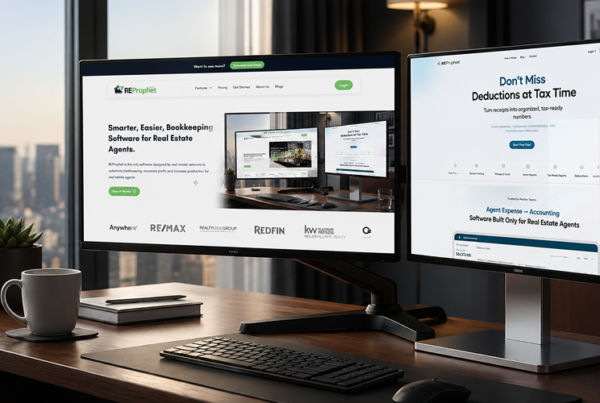
REProphet helps real estate agents automate bookkeeping, track profitability, and stay financially organized throughout the year so quarterly taxes become part of the plan — not a surprise.
Tax Disclaimer
This post is educational and general in nature, not individualized tax advice. Deduction eligibility depends on your specific situation, and tax rules change. Consult a licensed CPA or tax professional before filing.